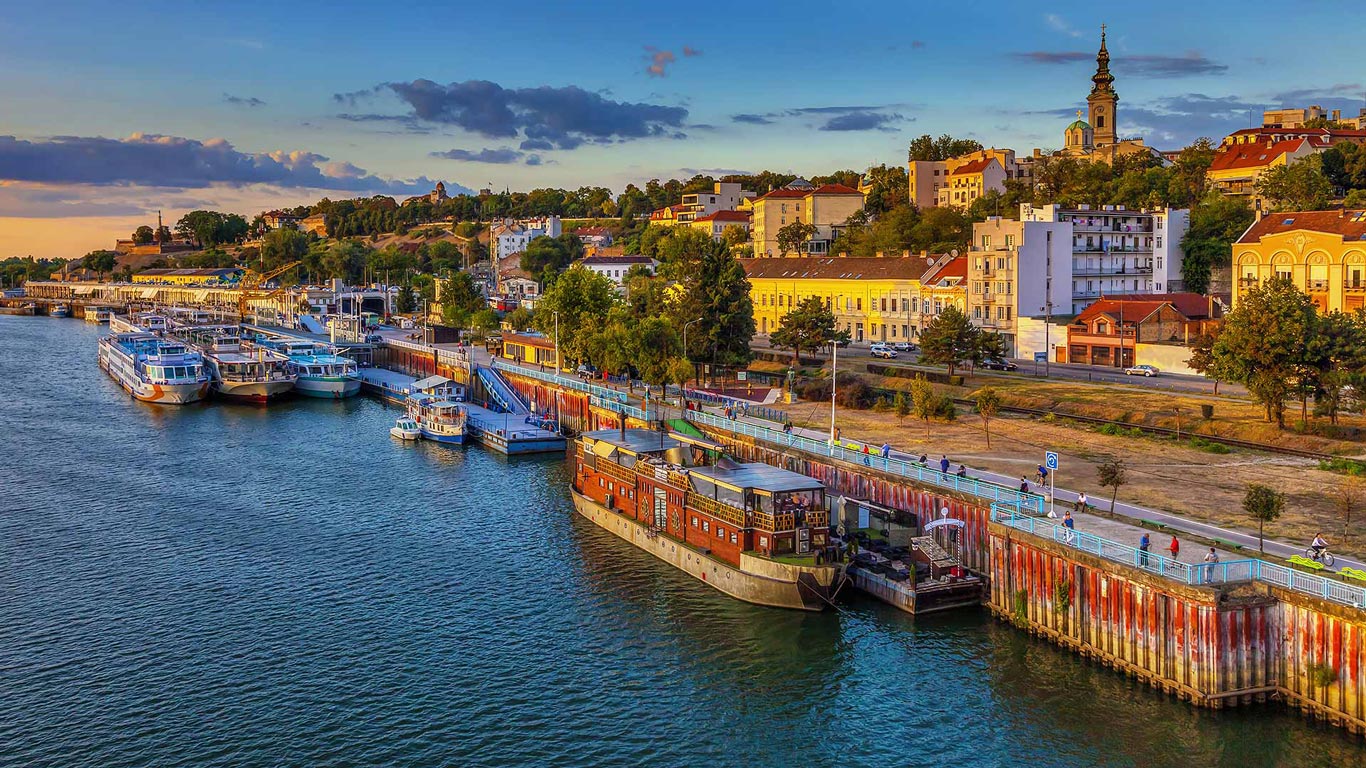
Belgrade (www.beograd.rs) is the capital and largest city of Serbia, with a very tumultuous history. Belgrade was the capital of Yugoslavia from 1918 to 1991. It is located at the confluence of the Sava and Danube rivers, where the Pannonian Plain meets the Balkans. One of the oldest cities in Europe, it has long been an important traffic hub, at the crossroads of Eastern and Western Europe. Today, Belgrade is the center of Serbian culture, education, science, and economy. Due to its turbulent past, many nations have lived in Belgrade for centuries. The official language is Serbian, though English is commonly used for communication with visitors. Belgrade uniquely combines oriental passion with European finesse. According to preliminary results of the 2022 census, the city has a population of 1,681,405. Its name translates to “White City” in English.
One of Europe’s largest prehistoric cultures, the Vinča culture, thrived here in the 6th millennium BC. In antiquity, the area was inhabited by Thraco-Dacians, and after 279 BC, it was conquered by the Celts, who named it Singidūn. It came under Roman rule during the reign of Augustus and was awarded city rights in the mid-2nd century. The Slavs settled here in the 520s. Over the centuries, Belgrade changed hands many times, becoming the capital of King Stephen Dragutin (1282–1316). In 1521, it was conquered by the Ottomans and frequently passed between Ottoman and Habsburg rule, suffering destruction during the Austro-Turkish wars. Belgrade became the capital of Serbia in 1841, while northern Belgrade remained an Austrian outpost until 1918. As a strategic location between East and West, Belgrade has witnessed 115 wars and was razed 44 times, only to be rebuilt each time. Unlike many European capitals, it does not have architectural continuity, but it compensates with abundant vitality, curiosity, and a great sense of humor — qualities that make Belgrade an unforgettable city.
Belgrade has a special administrative status within Serbia. Its metropolitan area is divided into 17 municipalities, each with its own local council. The city covers 3.6% of Serbia’s territory and is home to 25.3% of the country’s population.